Sunday, 27 October 2013

Autumn restart

With summer well and truly over, blackbirds have finished their post breeding moult and are becoming more obvious in the study site. This time of year is a good for spotting first year males - they will have brown outer wings, unlike adults which are a uniform black. 

http://blx1.bto.org/birdtrack
At this time of the year our resident blackbirds are also joined by birds from mainland Europe. These visitors are the same race (T. m. merula) as our resident birds. There is often great debate over whether male blackbirds with dark bills and eye rings are migrants from the continent or not. All first year male blackbirds will have these characteristics so they can not be relied on to determine the origins of these birds. However, at this time of year we do catch bird that differ in general size and feel different in the hand than "normal" and these could be migrant birds.
A winter visitor form the continent or a bird born locally late in the season? This
particular individual was noticeably smaller than would be expected compared to
birds we usually catch.
An easy to spot winter arrival whose numbers will be on the up in the next few weeks is the redwing. The BTO is looking for volunteers for its Winter Thrushes Survey which aims to map the distribution and work out the habitat needs of visiting fieldfares, redwings, mistle and song thrush and blackbirds. Were conducting the survey during our regular walks of the study site, although at the last visit we only recorded one redwing! We will keep you posted on our results but why not take part the survey yourself?


Saturday, 3 August 2013

Blackbirds Thin on the Ground

Despite AB and A4 putting in regular appearances recently, its becoming more difficult to re-sight our blackbirds simply because there are fewer blackbirds about! Only two blackbirds (including A4!) were seen during a walk around most of the study area yesterday.
 
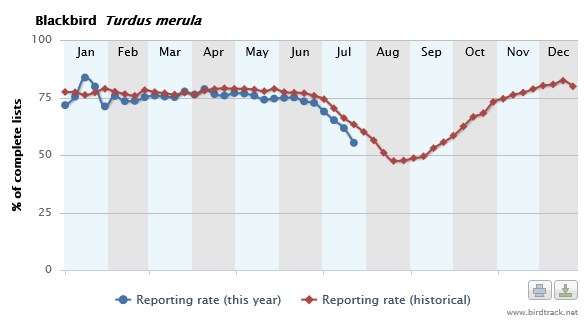
The detectability of blackbirds (as can be seen from the BirdTrack graph below) declines as the summer progresses. At this time of year the birds begin to go through their annual moult; a time when they renew their plumage an the birds tend to skulk in the undergrowth, keeping themselves to themselves. Although this behaviour reduces their vulnerability to predation it of course makes them harder to see! 
Reporting rates of blackbirds reported to BirdTrack show the seasonal change in the 'detectability' of the species. 
The blue line shows the reporting rate for 2013 and the red line shows the average reporting rate for all previous years.

Thursday, 18 July 2013

Relaxing in the sun

It appears it isn't just us humans that are taking advantage of this current spell of fine weather. On Tuesday a ringed male (sadly we didn't see his code) was seen foraging along the avenue that runs down the centre of study site. Having consumed a worm he walked quickly to a bare spot, turned around before fattening himself on the ground with his wings outspread.

Blackbirds are known to "ant" where by they lie near an ants nest, allowing the ants to clean parasites off them. However, after the bird had flown off the area was check for ants but none were found. This male might have just been taking time out to relax in the sun; and who could blame him!
 
This male was either 'anting' or sunbathing, either way he appeared to be
enjoying  himself in the midday sun.

BK was also spotted, in fact she was the only bird who's code we were able to read despite there being several others! She seems to have had some success in the breeding stakes as she was seen feeding a rather large, and noisy, fledgling.
 
BK looking watchful as her youngster was not too far away.
 

Monday, 15 July 2013

50 at last!

The project finally reached the milestone of 50 Blackbirds! The latest addition, an adult female ringed HP, was caught this evening while we working on another project. Hopefully the next 50 won't take so long!

Judging by the size of here brood patch she is likely breeding
close by to where she was caught.

Sunday, 14 July 2013

Catch Up

We must apologise for the lack of updates of late; with a delayed spring and blustery  (and sometimes wet!) start to the summer fieldwork for the project has been sporadic.

Much of our time of late has been re-sighting birds we’ve ringed over the last year for the RAS element of the project. This is also allowing us to build a picture of how the birds use the park. Some birds seem to hold very distinct territories (or are at least seen in discrete areas) while others wander a little more. So far we’ve re-sighted over 25% of the birds ringed in the last year, several of which have been collecting worms or feeding very plump fledglings. If you see any colour-ringed blackbirds then please let us know!

While some birds, such as A4 seem to stick to a discrete area, others like AB
apparently like to wander about more. However, the picture is far from complete
and we would welcome more records from the allotments!

Ringing sessions ceased for a couple of months while the birds began to breed during a very cold and delayed spring. These sessions started up again recently and we have managed to add two more birds, both this year’s young, bringing the project total to 49 (47 of which are colour ringed). These sessions not only allowed us to catch up with birds we have not encountered so far during the breeding season but also provided some interesting “by-catch” in the form of a kingfisher and a lesser whitethroat.

A3 was the 10th bird ringed for the project and was recently
re-caught less than 100m from where he was originally ringed
last May.
 

Sunday, 14 April 2013

Signs of Spring

Despite the weather we've been out and about in the study area re-sighting birds. In the paddocks near the weir (the very east of the study site) we caught up with CH and a colour ringed male but we could not read his ring combination.  He is likely to be AS, who was ringed and seen there in the past. CH was ringed in January of this year at the allotment feeding station, making her a long distance mover in terms of this project!The metal ringed only male was seen again. However, he seems to have lost his tail since the last time we saw him. Perhaps he has had a narrow escape from a sparrowhawk, cat or been in a brawl? Or perhaps its an entirely different bird?!

A ringing session in the paddocks failed to catch the metal ringed male. Although we were unsuccessful on that front we did manage to add two new birds to the project, bringing our total of colour ringed birds to 45 (project total 47). We also managed to catch a  Mistle Thrush, only the second one we've caught, and two chiffchaffs which is a sure sign that spring has finally arrived.


Above: The projects latest recruits; HB and CD. Sadly we didn't catch the
metal ringed male. Below: Chiffchaffs, and their close relative the Willow
Warbler, are migrating through the study site at the moment. Some
individuals will breed there too.
 
 
Casual re-sightings of birds along the main avenue has also revealed another sign of spring when C3, an adult female, was seen adding to an already full beak of worms. She was seen flying off over a hedge into the Pontcanna Permanent Allotments where she is obviously feeding a hungry brood; a timely reminder that spring has sprung and that we should start nest recording pretty sharpish!

Monday, 1 April 2013

Have we met before?

On the whole the recent weather has not be conducive to catching birds but we have managed the odd session. The last resulted in four new birds for the project bring our total to 43 colour ringed birds and 45 birds ringed since the project started. Among the four new birds was a male with a white chin spot. Hopefully this will be as a useful aid to identifying this bird as B6's white spot.

The white chin patch of one of our new males.
We have of course been continuing with re-sighting already ringed birds. One surprise while trying to re-sight birds in the east of the study site was coming across the male pictured below. Although several blackbirds have been ringed in other parts of Cardiff, prior to the start of the project only a handful of blackbirds had been ringed on our site; and only one of these was male. If this is LB09234, he is doing well as he will be in his fifth calender year!
 
Is this LB09234?